Should you invest the money in a basement renovation before selling your home? Consider these pros and cons from the team at Country Creek Builders.

You're planning to sell your Lakeville home next spring. The main floor is immaculate—updated kitchen, refreshed bathrooms, beautiful hardwood throughout. But your basement remains unfinished: concrete floors, exposed joists, that dusty accumulation of storage boxes and forgotten furniture. You're wondering whether investing $90,000 to $140,000 in basement finishing before listing makes financial sense.
This question keeps homeowners awake at night: Will I recoup my investment? Will buyers even care? Should I just sell as-is and let buyers finish it themselves? The wrong decision could mean leaving $50,000-$80,000 in equity on the table—or worse, spending $120,000 on finishing that only increases your home value by $60,000.
After completing 586+ basement projects across the South Metro and working with countless homeowners navigating this exact decision, we've seen which finishing investments pay off and which ones don't. We've watched sellers increase their home values by $75,000-$100,000 through strategic basement finishing, and we've seen others wish they'd left basements unfinished and reduced their asking prices instead.
This comprehensive guide analyzes the financial reality of finishing basements before selling: real ROI data from South Metro markets, scenarios where finishing makes sense, situations where it doesn't, alternative strategies worth considering, and how to maximize returns if you decide to finish.
ROI (Return on Investment) measures how much your home value increases compared to your finishing costs. A 70% ROI means spending $100,000 on finishing increases your home value by $70,000.
National data from Remodeling Magazine's Cost vs. Value Report shows basement remodels recoup approximately 70% of costs at resale. This average masks significant regional variations—markets differ dramatically.
South Metro Minnesota reality (Lakeville, Apple Valley, Prior Lake, Rosemount, Savage, Burnsville) presents more nuanced picture:
High-value homes ($400,000-$600,000+):
Mid-range homes ($300,000-$400,000):
Entry-level homes ($250,000-$300,000):
These ranges reveal critical insight: you rarely recoup 100% of basement finishing costs at resale. Even in best-case scenarios with premium properties and ideal market conditions, expecting more than 85% ROI sets unrealistic expectations.
Several factors prevent full cost recovery:
Functional square footage vs. above-grade square footage: Appraisers and buyers value basement space at 30-50% less per square foot than main-level space. Finishing 1,000 sq ft in your basement doesn't add the same value as adding 1,000 sq ft on your main floor.
Below-grade considerations: Basements lack natural light, may feel less comfortable, and carry moisture concerns regardless of quality finishing. These perceptions limit value potential.
Market saturation: Many South Metro neighborhoods have high percentages of finished basements. When 70% of comparable homes have finished basements, yours doesn't stand out as unique—it simply meets expected standards.
Overcapitalization concerns: Spending $140,000 finishing your basement in a $350,000 neighborhood may not make financial sense. Buyers shopping at $350,000 price points often lack budgets for homes listing at $450,000 even if the higher price reflects finishing investments.
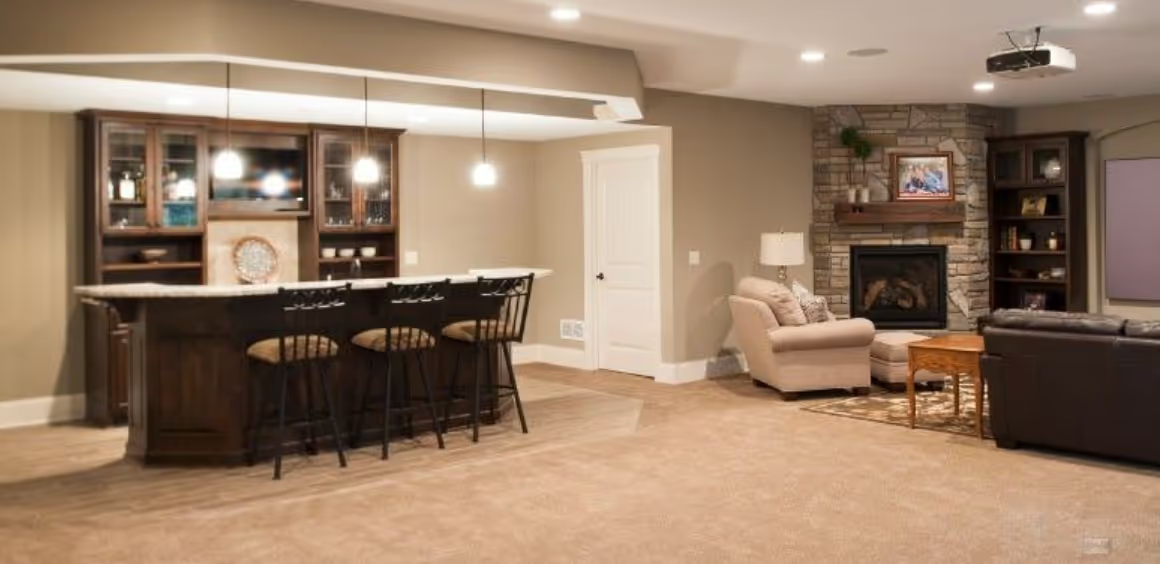
Personal taste differences: Your $140,000 Tier 4 basement with gas fireplace, large wet bar, and premium finishes may not align with every buyer's preferences. Some buyers prefer different layouts, styles, or would rather spend less for simpler finishes.
Not all basement finishing projects generate identical returns. Several factors significantly affect ROI:
Property location and value:
Market conditions:
Quality of finishing:
Basement configuration:
Timeline to sale:
At Country Creek Builders, we help homeowners understand these factors during initial consultations, ensuring realistic expectations about what basement finishing will and won't achieve financially.
While basement finishing rarely recoups 100% of costs, specific situations generate optimal returns justifying the investment.
Scenario: You own a $500,000 home in a sought-after Lakeville neighborhood near excellent schools. Comparable homes in your area list for $550,000-$600,000 when they have finished basements, and your unfinished basement is the only thing preventing you from reaching those price points.
The numbers:
Why this works: In premium markets, buyers expect finished basements. An unfinished basement becomes a significant objection preventing offers at market-appropriate prices. Finishing removes this objection and positions your home competitively against comparables.
Additionally, buyers at $550,000-$600,000 price points often have budgets supporting these prices and appreciate move-in-ready homes. They're not looking to take on finishing projects themselves—they want to write a check and move in.
Scenario: You're selling in Apple Valley where 75% of comparable homes feature finished basements. Your unfinished basement makes your home the odd property out, forcing price reductions to compensate for the missing amenity.
The numbers:
Why this works: When most comparable homes have finished basements, yours needs one to compete. The "cost" of not finishing isn't just the missed value increase—it's also the extended time on market, multiple price reductions, and eventual sale below market expectations.
Finishing brings your home to market standards rather than asking buyers to overlook a significant deficiency. In these situations, the question isn't "Should I finish?" but rather "Can I afford not to finish?"
Scenario: Your basement has proper egress windows and layouts supporting legal bedrooms. Converting your 3-bedroom home to a 5-bedroom home through basement finishing changes your home's market category and buyer pool.
The numbers:
Why this works: Adding bedrooms doesn't just add square footage—it fundamentally changes your home's appeal and target market. Families needing 4-5 bedrooms for growing families, home offices, guest rooms, or multi-generational living actively seek these configurations.
The South Metro market shows consistent premiums for homes with 4+ bedrooms, especially in good school districts. While ROI doesn't reach 100%, the increase in buyer pool and competitive positioning often makes finishing worthwhile.
Scenario: You're selling during peak spring selling season in a seller's market where inventory is low and buyer competition is high. Finished basements differentiate your property and justify premium pricing.
The numbers:
Why this works: In hot markets, buyers pay premiums for move-in-ready homes. Your finished basement becomes a competitive advantage that shortens time on market, generates multiple offers, and supports prices above typical ROI expectations.
Market conditions significantly affect whether finishing makes sense. The same basement that generates 75% ROI in a seller's market might only achieve 65% ROI during a buyer's market with high inventory.
Scenario: Your home is priced below neighborhood comps due to an unfinished basement. Finishing brings your property to market potential without overcapitalization concerns.
The numbers:
Why this works: You're not trying to exceed neighborhood norms—you're catching up to them. Finishing eliminates the discount your home suffers for lacking an expected amenity, allowing you to reach market-appropriate pricing.
This scenario generates the best ROI because you're correcting an undervaluation rather than trying to create premium positioning. Your home has "equity opportunity" that finishing unlocks.
Basement finishing doesn't always make financial sense. Several scenarios suggest selling with unfinished basements and adjusting prices accordingly.
Scenario: You're selling a $275,000 home in a market where buyers typically have limited cash reserves and are stretching to afford monthly payments. The buyer pool can't comfortably support $360,000 price points even with beautiful finished basements.
The numbers:
Why finishing doesn't make sense: You'd spend $85,000 to gain $50,000 in value—effectively losing $35,000. Buyers in this price range often prefer lower purchase prices over finished amenities, planning to tackle finishing themselves when finances allow.
Additionally, buyers at this price point may have different preferences for layouts and finishes. Forcing them to pay for your choices removes their flexibility to finish according to their needs and budgets.
Better strategy: Sell unfinished at $275,000 and accept that buyers are purchasing potential rather than completed square footage. Price competitively against comparable unfinished basements in your area.
Scenario: You're selling during economic uncertainty, rising interest rates, or other market conditions creating buyer hesitation. Months of inventory are accumulating, and homes sit on market longer than typical.
The numbers:
Why finishing doesn't make sense: Weak market conditions compress ROI even below normal 70-75% ranges. Buyers have more options and negotiate harder, reducing your ability to capture value from finishing investments.
Money spent on basement finishing before selling in uncertain markets would be better saved or invested elsewhere. If your home doesn't sell quickly despite finishing, you've committed substantial capital to an illiquid investment.
Better strategy: Price aggressively with unfinished basement and sell quickly, or wait for market conditions to stabilize before considering pre-sale finishing.
Scenario: Your home needs roof replacement ($15,000), updated kitchen ($35,000), and bathroom refreshes ($20,000) before it'll sell at market rates. Finishing the basement doesn't address these more critical issues.
The numbers:
Why finishing doesn't make sense: Essential updates generate better ROI than basement finishing. A house with a new roof, updated kitchen, and refreshed bathrooms but an unfinished basement sells better than a house with aging mechanicals, dated main-level spaces, and a beautiful basement.
Buyers prioritize function over optional amenities. Address critical needs before considering discretionary improvements like basement finishing.
Better strategy: Invest in essential updates that make your home marketable and competitive, accepting that the basement remains unfinished as a buyer opportunity.
Scenario: Life circumstances require selling within 3-4 months. Basement finishing typically takes 6-10 weeks for design and permitting, 8-12 weeks for construction, meaning 4-5 months minimum from decision to completion.
The numbers:
Why finishing doesn't make sense: You can't finish before listing deadlines. Attempting to finish while listed creates complications:
Better strategy: List immediately with unfinished basement and focus on showing existing home's strengths. Price appropriately for unfinished status and move on with your life according to required timeline.
Scenario: You're considering DIY basement finishing or hiring unlicensed contractors to reduce costs. The result may not meet professional standards or buyer expectations.
The numbers:
Why finishing doesn't make sense: Poor-quality finishing doesn't generate typical ROI and may actually hurt your home's marketability. Savvy buyers recognize amateur work and factor correction costs into offers. Some won't make offers at all when seeing code violations or poor craftsmanship.
You might spend $45,000 only to receive buyer feedback about "substandard basement finishing" that needs redoing—effectively gaining nothing while creating problems.
Better strategy: Don't finish at all if you can't afford professional work meeting standards. Unfinished basements carry no quality concerns; poorly finished basements create red flags for buyers.
Between fully finishing your basement before selling and leaving it completely unfinished, several middle-ground approaches deserve consideration.
Instead of comprehensive $110,000 finishing, consider targeted improvements in spaces buyers see first or value most.
Strategic partial finishing approach:
Phase 1 - Cosmetic basement improvements ($8,000-$15,000):
Benefits:
Drawbacks:
This approach works well in markets where some comparable homes have unfinished basements and buyers appreciate potential rather than completion.
Provide buyers with professional basement finishing plans, permits, and contractor estimates showing exactly what finishing could achieve and cost.
Investment: $2,000-$5,000 for:
Benefits:
Marketing advantage: "Seller provides complete finishing plans valued at $5,000 plus $10,000 finishing credit toward buyer's project."
This $15,000 investment often generates $20,000-$30,000 in perceived value—buyers appreciate the homework being done and the financial assistance provided.
Offer buyers cash credits toward basement finishing in lieu of completing work yourself.
Typical structure:
Benefits:
Considerations:
This strategy works particularly well with first-time buyers, DIY-inclined purchasers, or anyone wanting to customize finishing to their specific needs.
Transform your unfinished basement into compelling showpiece without full finishing investment.
Approach:
Investment: $3,000-$8,000 for:
Benefits:
Professional staging helps unfinished basements sell for 5-10% more than unstaged basements by helping buyers see potential rather than empty concrete spaces.
Some basement finishing contractors offer programs where sellers pre-purchase finishing work with warranties transferring to buyers after closing.
Structure:
Benefits:
This innovative approach emerging in some markets provides middle ground between seller finishing and buyer uncertainty.
If your analysis suggests finishing makes sense, strategic decisions significantly affect returns.
Not every basement needs Tier 4 premium finishing with gas fireplaces and large wet bars. Match finishing quality to neighborhood norms and buyer expectations.
Tier 1 finishing ($85k-$100k): Appropriate for:
Tier 2 finishing ($100k-$125k): Optimal for:
Tier 3 finishing ($125k-$140k): Justified for:
Tier 4+ finishing ($140k+): Consider only for:
At Country Creek Builders, we guide homeowners toward finishing tiers matching their home values and market positioning. Over-improving generates poor ROI; under-improving fails to maximize value.
Basements with bedrooms, bathrooms, and practical living spaces generate better ROI than purely recreational finishes.
High-ROI basement features:
Lower-ROI basement features:
Prioritize features with broad market appeal over specialized spaces reflecting your unique interests.
Selling during peak season (April-June) with recently completed basement finishing generates optimal ROI.
Strategic timing:
This timing achieves three goals:
Avoid listing immediately after finishing completion—giving yourself 2-3 months with your finished basement provides personal benefit beyond financial returns while still capturing maximum value at sale.
Resist temptation to finish according to your personal preferences if selling soon. Choose finishes appealing to the widest buyer pool.
Broad-appeal choices:
Narrow-appeal choices to avoid:
Remember: buyers mentally deduct "correction costs" when seeing finishes they'd change. Every element requiring replacement to match their preferences effectively reduces your ROI.
Poor-quality basement finishing reduces ROI significantly. Buyers recognize and discount amateur work, permit violations, and code non-compliance.
Professional contractor benefits:
Investment protection:At Country Creek Builders, our systematic approach to basement finishing ensures every project meets code requirements, passes inspections, and delivers quality that appeals to buyers. Our 25+ years of experience and 586+ completed projects mean we understand exactly what creates value in South Metro markets.
Working with licensed, experienced contractors costs more upfront but protects your ROI by ensuring quality work that buyers appreciate and appraisers recognize.
Understanding how basement finishing affects actual sales provides practical perspective beyond theoretical ROI calculations.
Property details:
Homeowner decision: Invest $125,000 in Tier 3 finishing before selling
Basement scope:
Results:
Why this worked: Premium neighborhood where buyers expected finished basements. The addition of two legal bedrooms changed the home from 4-bedroom to 6-bedroom, expanding the buyer pool significantly. Multiple offers pushed the final price above asking despite "only" 66% ROI on the finishing investment.
The homeowners also enjoyed their finished basement for 4 months before listing, providing personal benefit beyond financial returns.
Property details:
Homeowner decision: Sell unfinished rather than spend $95,000 on finishing
Reasoning:
Strategy: Invested in kitchen and bathroom updates, left basement unfinished
Results:
Why this worked: Critical main-level updates generated much better ROI than basement finishing would have. Buyers appreciated the updated kitchen and bathrooms, accepting the unfinished basement as normal for the price point. Compar basements in similar condition sold for similar prices—the kitchen updates were the differentiator that drove value.
Property details:
Homeowner decision: Invested $88,000 in Tier 1+ finishing before selling
Basement scope:
Results:
Why this didn't work: The homeowner overcapitalized for the neighborhood. Buyers shopping at $280,000-$330,000 price points couldn't stretch to $365,000 even with the finished basement. After three price reductions over 87 days, the home finally sold at $332,000—essentially recovering only half the finishing investment.
The homeowners would have been better selling immediately at $285,000 rather than spending $88,000 to net only $47,000 more after months on market and carrying costs.
Lessons learned: Property value and neighborhood position matter more than finishing quality. Don't finish basements if the investment pushes your home substantially above typical market values for your area.
Property details:
Homeowner decision: Invested $105,000 in Tier 2 finishing before listing
Basement scope:
Results:
Why this worked: In a market where most comparables had finished basements, the unfinished basement was a competitive disadvantage that would have required significant price reduction to sell. Finishing brought the home to market standards, eliminated objections, and supported pricing consistent with neighborhood comparables.
The ROI exceeded typical ranges because finishing corrected an undervaluation rather than trying to create premium positioning. The home could finally compete equally with neighborhood comps instead of selling at a discount.
Research comparable sales in your area. If 70%+ of recent sales in your price range had finished basements, finishing is likely expected. If only 30-40% were finished, leaving yours unfinished won't create competitive disadvantage. Your real estate agent can provide this comp analysis.
Rarely. Even in best-case scenarios, expect to recoup 75-85% of finishing costs. The only exceptions occur when fixing dramatic undervaluations or when market conditions create unusual buyer competition.
No strict minimum, but 6-12 months allows you to enjoy the investment while still capturing maximum value. Finishing immediately before listing (within 1-2 months) generates full ROI potential. Waiting 10+ years means styles date and materials show wear, reducing ROI to 60-70%.
No. The market determines value, not your costs. Revealing you spent $130,000 creates anchoring bias—buyers may offer less thinking you're desperate to recoup costs, or may question whether finishing should have cost that much. Let the home's quality and market position determine value.
Quality DIY work by skilled homeowners can improve ROI by reducing labor costs. However, poor-quality DIY work reduces ROI significantly and may create legal issues if code violations exist. Additionally, buyers often discount DIY work vs. professional installations. Only DIY if you have legitimate skills and can obtain proper permits/inspections.
Address them before considering finishing. Buyers will discover moisture issues during inspections, killing deals or forcing price concessions. Investing $100,000 in finishing over unresolved water problems wastes money—you'll spend thousands correcting moisture issues AND lose deal momentum. Fix waterproofing problems first, then decide about finishing.
Yes. Professional renderings showing finishing potential help buyers visualize possibilities and typically cost only $500-$1,500. This small investment often generates $5,000-$15,000 in perceived value by helping buyers see beyond raw concrete and exposed joists.
Sometimes. If finishing increases your home value by $80,000 and closing costs total $30,000, you net $50,000 after costs vs. your $100,000 finishing investment—still losing $50,000 overall. However, the faster sale and potentially better terms may offset some losses. Never finish solely to cover transaction costs—that math rarely works out favorably.
Deciding whether to finish your basement before selling requires analyzing your specific situation against broader market realities. The right choice balances financial returns with practical considerations like timeline, budget, and market positioning.
Here's your action plan:
Step 1: Request comparative market analysis from your real estate agent showing how finished vs. unfinished basements affect values in your neighborhood and price range
Step 2: Calculate realistic finishing costs for your basement size and necessary features (contact us for accurate estimates)
Step 3: Determine expected ROI by comparing finishing costs to likely value increases based on local comp data
Step 4: Evaluate your timeline—can you finish before you need to sell, or would construction overlap with listing period?
Step 5: Assess whether finishing addresses competitive disadvantages or simply adds incremental value
Step 6: Consider alternative strategies (partial finishing, credits, professional plans) as middle-ground options
Step 7: Make your decision based on financial analysis rather than emotion or anecdotal advice
At Country Creek Builders, we've helped countless South Metro homeowners navigate this exact decision. Our 25+ years of experience includes working with sellers who finished successfully and sellers who chose alternative approaches—we understand both sides of this question.
If finishing makes sense for your situation, our systematic basement finishing approach ensures optimal ROI through strategic tier selection, broad-appeal finishes, and quality construction that shows well and passes inspections. We'll help you maximize returns while creating spaces buyers appreciate.
If finishing doesn't make financial sense, we'll tell you honestly and help you understand alternative strategies that achieve your selling goals without unnecessary investment.
Ready to determine whether basement finishing makes sense before selling your home? Contact us for a no-pressure consultation where we'll assess your basement, discuss your timeline and goals, and provide realistic cost estimates and ROI projections based on your specific market position.
Because the right decision isn't always finishing—it's understanding your situation well enough to make the choice that serves your financial interests best.
We're based out of the South Metro Twin Cities, and we serve both

.avif)
.avif)